
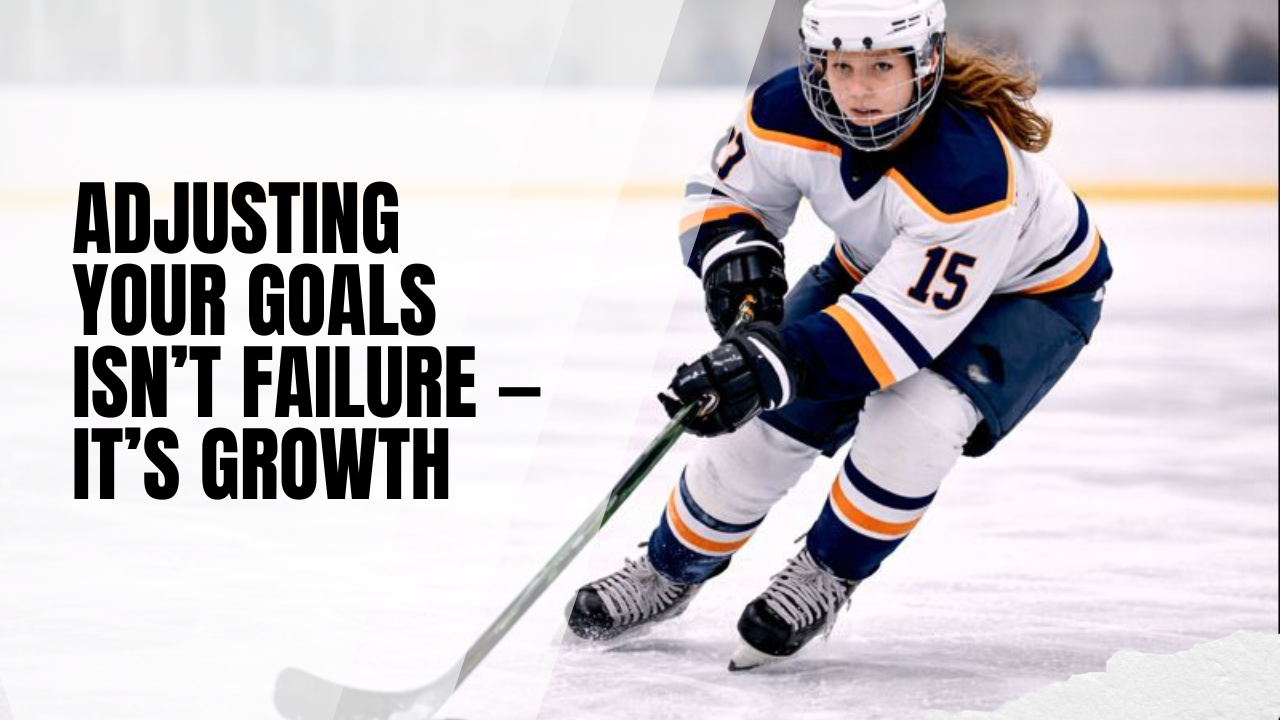
Adjusting Your Goals Isn’t Failure — It’s Growth
Jan 18, 2026There’s a belief in sports (and in life) that once a goal is set, that’s it – it shouldn’t change.
That if you adjust your plan, pivot your focus, or redefine what success looks like, you’ve somehow failed.
But that belief couldn’t be further from the truth.
Adjusting your goals doesn’t mean you failed.
It means you’re paying attention.
And if you’ve been with me for a while you know that self-awareness and self-reflection are extremely important. They are two of the first things I teach the athletes in my programs. So instead of beating yourself up here, take a second and celebrate the fact that you are aware enough to recognize a need for an adjustment! Then, read on.
Growth Is Rarely Linear
Athletes are often taught to push through, grind harder, and stay locked in on outcomes. While perseverance matters, growth doesn’t happen in a straight line.
There are peaks and plateaus.
Moments of clarity and moments of confusion.
Times when things click — and times when they don’t.
That’s not a problem.
That’s the process.
When athletes expect progress to be linear, they tend to interpret any disruption as failure. When they understand that progress includes adjustment, they build resilience instead of frustration.
Reflection Is a Skill, Not a Setback
Reflection isn’t about overthinking or dwelling on what went wrong. It’s about gathering information without judgment.
It allows athletes to pause and ask:
- What’s working right now?
- What feels heavy or forced?
- What has changed since I set this goal?
- What do I need more of?
- What do I need less of?
Awareness allows us the opportunity to reflect.
Then, reflection creates more awareness.
That new awareness creates choice.
And choice is where confidence begins to grow.
Changing Direction Isn’t Quitting
One of the most important lessons athletes can learn is this:
Changing direction isn’t quitting.
It’s learning.
It’s responding to new information.
It’s adapting to growth, context, and reality.
Athletes who feel permission to adjust are more likely to:
- Stay engaged during challenging stretches
- Maintain confidence when things don’t go as planned
- Communicate honestly with coaches and parents
- Develop self-trust instead of self-criticism
Rigid goals often create pressure.
Flexible intentions create progress.
Strong Seasons Start With Intention, Not Pressure
When pressure leads, athletes rush.
When intention leads, athletes grow.
Strong seasons don’t begin with forcing outcomes or clinging to expectations that no longer fit. They begin with clarity, reflection, and small, intentional shifts.
Reflection → adjustment → progress.
That cycle is where real development happens — not just in performance, but in confidence, resilience, and self-awareness.
A Final Reminder
If your athlete feels off track right now…
If goals need to be reshaped…
If expectations look different than they did a few weeks ago…
That doesn’t mean they’re behind.
It means they’re growing.
And learning how to adjust with intention is one of the strongest mental skills an athlete can build — in sport and far beyond it.
